Do we have the kind of freedom or control over our choices and actions needed to be “accountable” or “responsible” for them, in the ways that let us deserve the reactions (social practices and attitudes) we were discussing?
This kind of freedom or control has been challenged from several directions.
One sort of challenge has to do with the idea that all our choices and actions are causally predetermined by how we’re built and how the world is. Some argue that this means our choices and actions aren’t free or up to us — and maybe shouldn’t even really be called “our” choices. The notion of Determinism invoked here is what we’ll mainly be focusing on in the coming weeks.
Some related challenges have to do with ideas about chance or luck. We’ll also be discussing these in coming weeks.
For now, let me postpone explaining exactly what these notions of Determinism and Luck amount to, and how philosophers argue they do or don’t relate to freedom and control. These will be large complex discussions that we’ll take up in upcoming webnotes.
There are further directions from which challenges to free will are raised. These won’t be ones we focus on, but I’ll mention them here to help orient you if they come up in your thinking or reading.
Some challenges have to do with the idea of “fate” or “destiny.” This may come from “the will of the gods,” or some purpose hardwired into the universe. Another place these ideas can come up is in fiction about time travel, since that may posit that the future is “already real,” or that it’s in some sense “already true” what’s going to happen. Some philosophical discussions of time also accept that posit. This idea is different from Determinism in subtle ways, that we won’t be able to explain until we’ve thought more carefully about what Determinism says.
Some challenges have to do with someone’s already knowing what the future holds. This may be an oracle or prophet or a time traveller, and can also be described using notions like “fate” or “destiny.” Some important discussions in the history of philosophy turned on whether the fact that God already knew what choices you would make was compatible with you having freedom or control over those choices. These worries about God’s foreknowledge work differently than the previous worries, which could be presented in terms of God’s will.
For any of these challenges, one way to respond to them is to deny their premises. We’ll be considering some positions of this kind for the challenges coming from Determinism and Luck.
Another way to respond to the challenges is to concede (some or all of) their premises, but argue that no dire conclusions about free will follow from them.
For example, some philosophers think that Determinism is true, and thus that we can’t have free will. Other philosophers agree we would lack free will if Determinism were true, but argue that it’s not true.
Both those groups of philosophers agree that Determinism is incompatible with our having free will. So we call them Incompatibilists. They think you can’t have both. If you’ve got one, you can’t have the other.
However, not every philosopher agrees about that. In fact, more philosophers would instead say that it’s possible for Determinism to be true and yet we still have free will. These philosophers are called Compatibilists.
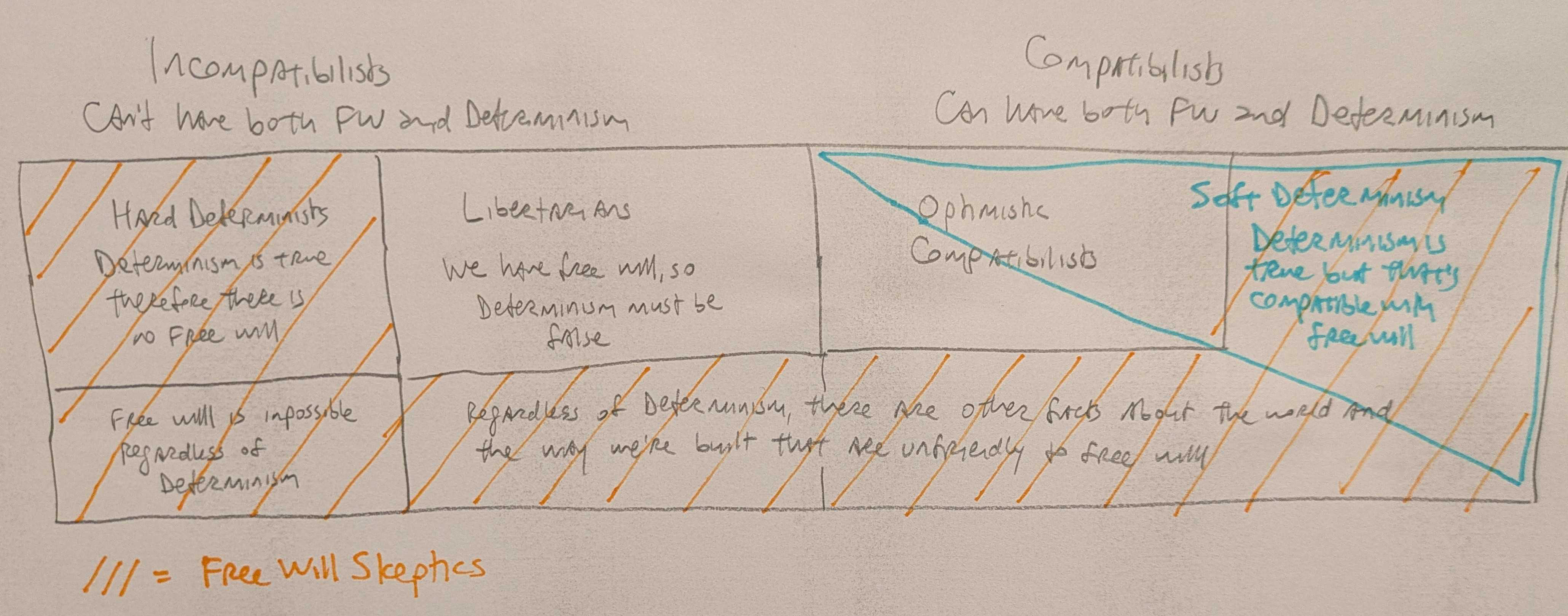
We can further sub-divide the Incompatibilists and the Compatibilists as follows:
|
| ||||||
In a large poll of philosophers in 2020, 15% of the respondents favored us having no free will, 17% favored Libertarianism (so altogether, 32% were Incompatibilists), and 56% favored Compatibilism. (The remaining 12% were undecided, thought the question was too unclear, or that there’s no fact of the matter, and so on.) Philosophy isn’t a popularity contest, so these numbers don’t tell us which view is right. But they do show how much controversy there is, and that each of these positions has some serious support.
We can be a bit more careful about our map of positions.
We’re going to call everyone who thinks we lack free will a Free Will Skeptic. Sometimes in philosophy, as here, “skeptic about X” means someone who thinks X doesn’t exist. Other times it means someone who thinks we can’t know whether X exists or what X is like. This includes the position above labeled “Hard Determinists,” but not only them. You might think that Determinism is false, but that we lack free will for other reasons. Or you might not be sure whether Determinism is true, but think we lack free will either way.
Sometimes this group of Free Will Skeptics are called “Pessimists” or “Hard Incompatibilists.” (In the Lemos textbook, the Professor Goldfarb character applies the second label to himself.) But as I understand the view, it could include some Compatibilists too, just not ones that are “Optimistic” (see below). Also, not all of these Skeptics think of themselves as pessimistic (we’ll discuss this below, too).
Libertarians think we have free will and that this is incompatible with Determinism being true, so Determinism must be false. There are some importantly different flavors of Libertarianism, that we’ll talk about when we get to these views in a few weeks.
In the Lemos text, these views are represented by Professor Ryan.
In principle, you could be a Compatibilist, and so think that Determinism is compatible with free will, but think that as a matter of fact we don’t have free will. Perhaps because of details about the way we’re built, or maybe for other reasons. In our discussion, we’re only going to be thinking about Optimistic Compatibilists, who think Determinism is compatible with free will, and also that ordinary people do (at least sometimes, maybe even often) act freely and make free choices. When these theorists happen to think Determinism is true, they’re called “Soft Determinists,” but some of them may think Determinism is false, or be agnostic.
In the Lemos text, Optimistic Compatibilism is represented by Professor Daniels. He seems to be agnostic about whether Determinism is actually true.
Here is our more refined map:
The rest of this page will discuss the orange-striped region, which holds Free Will Skepticism.
In upcoming webnotes, we’ll think more carefully about what Determinism means, and discuss an argument some philosophers give that is supposed to establish Incompatibilism.
Then we’ll talk about Luck, and shift into considering Optimistic Compatibilists for a few classes.
Finally, we’ll consider different things people say for and against Libertarianism.
If you’re a Free Will Skeptic, what do you think the social fallout of your view would or should be?
Some Skeptics will be reconcilers or preservationists, who argue that accepting the lesson that there’s no free will doesn’t need to radically undermine our existing social practices and attitudes — nor to radically change them in other ways. When this lesson is properly understood, it will make only minor differences to how we live and react to and feel about each other. Our reading from Pereboom defends this kind of view. Goldfarb in the Lemos textbook seems to fall in this camp too.
These Skeptics do think the lesson that there’s no free will may lead us to feel some negative emotions less strongly: resentment, indignation, desire for revenge, intolerance. We may also be less quick to blame victims of misfortune for their own situation.
Other Skeptics will be stronger revisionists or reformers, who argue that once we accept there’s no free will, we would or should substantially change our social practices and attitudes. As described in the Rachels reading, the lawyer Clarance Darrow was a “reformer” in this sense. Some of these changes may be attractive, such as us reacting better when people harm us. Others may be unattractive, such as more cheating, crime, aggression, and xenophobia.
Some Skeptics will be concealers or illusionists, who think that if people accepted there is no free will, some of the social consequences would be so unattractive, that it’s best for most of society to stay in the dark, and continue thinking (wrongly) that we still have free will.
Of course, if we have no free will, you might ask whether it’s worthwhile for us to inquire or argue about these questions (or anything else). It won’t be up to us who accepts the Skeptic’s lesson, or what social effects that has. If people do accept the lesson, it won’t be up to us or them whether it makes them depressed, or frustated, or relieved. On the other hand, neither would it be up to us whether to inquire or argue about these questions. So… (shrug)
When you’re asking what justifies some social practice, sometimes people focus on what are called instrumental or consequentialist or utilitarian or forward-looking reasons. These have to do with good results you can expect to follow from us treating and interacting with agents in that way.
For example, say I catch you cheating on a test. Perhaps I know that most students cheat. Perhaps I cheated myself when I was in your shoes. So maybe you don’t really deserve to be punished, at any rate not very harshly. But I know that if I do punish you harshly, that will make you and also your friends less likely to cheat in the future. That would be an instrumental or consequentialist reason for punishing you. Punishing you would have that good effect. (Of course, it may also have bad effects, for example making you resent me.)
A different kind of justification for punishing you would be that you deserve punishment — that your action reflects on you or your choices in a way that makes that the appropriate reaction for us to have. Perhaps it would even be wrong to let you off without punishment. When philosophers talk about these kinds of considerations justifying a reactive social practice, they call them desert-based or retributivist or backward-looking reasons.
Try not to confuse the concepts of dessert (ice cream), deserts (sand and cactus), deserting (the army), and “desert” or “deserving” as used here.
The doctrine of “an eye for an eye, a tooth for a tooth” is an example of a retributivist picture. But the core idea here doesn’t have to commit to any specifc position about what fair penalties look like, or when a wrongdoer may / should be excused or forgiven. The core idea is just that wrongdoers sometimes do deserve our negative reaction; and similarly, good-doers sometimes also do deserve our positive reaction. You might allow that when agents destroy my eye or tooth, the fair or deserved penalty is for them to spend some time in jail, rather than suffer the same harms. You might allow that when agents murder, what they deserve is not as severe as losing their own life.
It’s also possible to say there are cases where what agents deserve is one penalty P, but facts about their situation make it better or more appropriate for us to impose lesser sanctions than P. That is, you don’t have to say that sanctions are always justified when they’re deserved; only that their being deserved is necessary for them being justified.
There’s debate about which social practices and attitudes are justified by which kind of reasons. (Some may be justfied by both.) It’s generally assumed that necessary conditions for being accountable and deserving a reaction — whether it be a negative reaction like blaming or resenting, or scolding or punishing, or a positive reaction like praising or being grateful — these necessary conditions include that the agent actually have performed the act / made the choice we’re reacting to, and that the agent did so freely. This is the idea we described earlier as “Cloud-1 being a necessary condition for the concepts in Cloud-3.” If in fact you’re innocent of the crime, you don’t deserve to be punished for it. If you were coerced or manipulated into committing it, again you don’t deserve to be punished, or at any rate, not punished to the same extent as if you committed it freely.
As we discussed before, possibly there are other necessary conditions on deserving as well. Some argue that you only deserve to be punished if you knew what you were doing, that it was wrong, and why it was wrong.
The important point for our purposes is that, under Free Will Skepticism, since nobody acts or chooses freely, these desert-based reasons won’t be present.
So our social practices and attitudes will either no longer “make sense” — no longer be appropriate and justified — or what justifies them will have to be instrumental or consequentialist reasons only.
The reconcilers in our readings argue that existing parts of our lives, such as our legal system and institutions for punishment, as well as the ways we react to each other in day-to-day life, are sufficiently justified by such instrumental or consequentialist reasons. When it comes to institutionalized punishment, these considerations include:
One of the main objections to these views is that, in principle, nothing stops these benefits from attaching to people who haven’t yet done anything wrong. If we have an unsolved murder, and are in a position to effectively frame someone innocent for it, doing so might achieve as much deterrence as prosecuting someone guilty. There might also be people we can reliably predict are likely to become dangers to society, though they haven’t yet harmed anyone. On views where what justifies imprisonment and other kinds of punishment or sanctions are only forward-looking reasons, wouldn’t these views recommend imprisoning all these innocents? Doesn’t that seem morally problematic?
Even if we restrict our attention to subjects who we know did commit some crime, these views might also sometimes recommend very harsh punishments for minor offenses. If you get your hand cut off when caught cheating on a test, that may be a very good deterrent for other students. But wouldn’t that punishment also seem morally problematic?
Our sense that those kinds of punishment would be unfair, undeserved, shows how strongly we have backward-looking intuitions about what are appropriate ways to interact with each other. And so, how intuitively committed we are to the idea that people can choose and act freely. Since that is necessary for deserving any given reaction to what you do.
If attitudes like blaming, resenting, being grateful, and admiring are connected to the idea that agents deserve these reactions, because of how they freely chose and acted, then Skepticism about free will is going to undermine them. Some Skeptics argue that we can replace such attitudes with “healthier” alternatives that play most of the same socially valuable roles. They argue also that Skepticism is compatible with continuing to respect other agents and have valuable personal relationships with them.
Many of the Skeptics’ critics argue this isn’t so. Critics also argue that Skepticism will undermine moral motivation and evaluation — the idea that some things ought not to happen, that some actions and lives are better than others.
Of course, these flaws wouldn’t by themselves show that Skepticism is wrong, only that it would be bad if it were true.
Some Skeptics acknowledge these threats. Others resist, arguing that even if notions like “moral accountability” and “blameworthiness” require free will, other parts of morality will not, including the notions of obligation, virtue, and right and wrong.
These issues are vigorously debated.